
After several seasons in which the bodice was held up by construction alone and shoulders stayed bare, the new collections have quietly brought back the gown that hangs from two fine straps. The slip silhouette — a dress that slides down the body without a single unnecessary seam — now reads as confident rather than merely simple.
Why the strap returned
Strapless remains the most requested neckline, and that is precisely why a narrow strap across the shoulder has become interesting again. It does two things at once: it frees the shoulders from the pressure of a built bodice, and it opens the neckline into a softer, slightly lowered shape. Instead of a straight line cutting across the chest, you see the neck, the collarbone and the arm in one unbroken sweep.
In the newest collections the strap is rarely a purely technical detail. It appears doubled, as two fine ribbons side by side; as the continuation of a draped neckline that spills into a soft fold; or as a band set deliberately lower, at the very edge of the shoulder. Sometimes it is marked with a small detail where it crosses onto the back — exactly where guests look longest.
The fabric carries the whole dress
A gown like this has no boning, no embroidery, no volume to correct the cloth. Everything depends on the material and on how precisely it has been cut.
- Heavier satin falls in long, calm verticals and catches light in ribbons; it is at its best in daylight.
- Crepe is matte, denser and the most forgiving — it holds the line and does not follow every movement underneath.
- Light silk cut on the bias gives the most fluid line, but asks for faultless making and a little more patience at fittings.
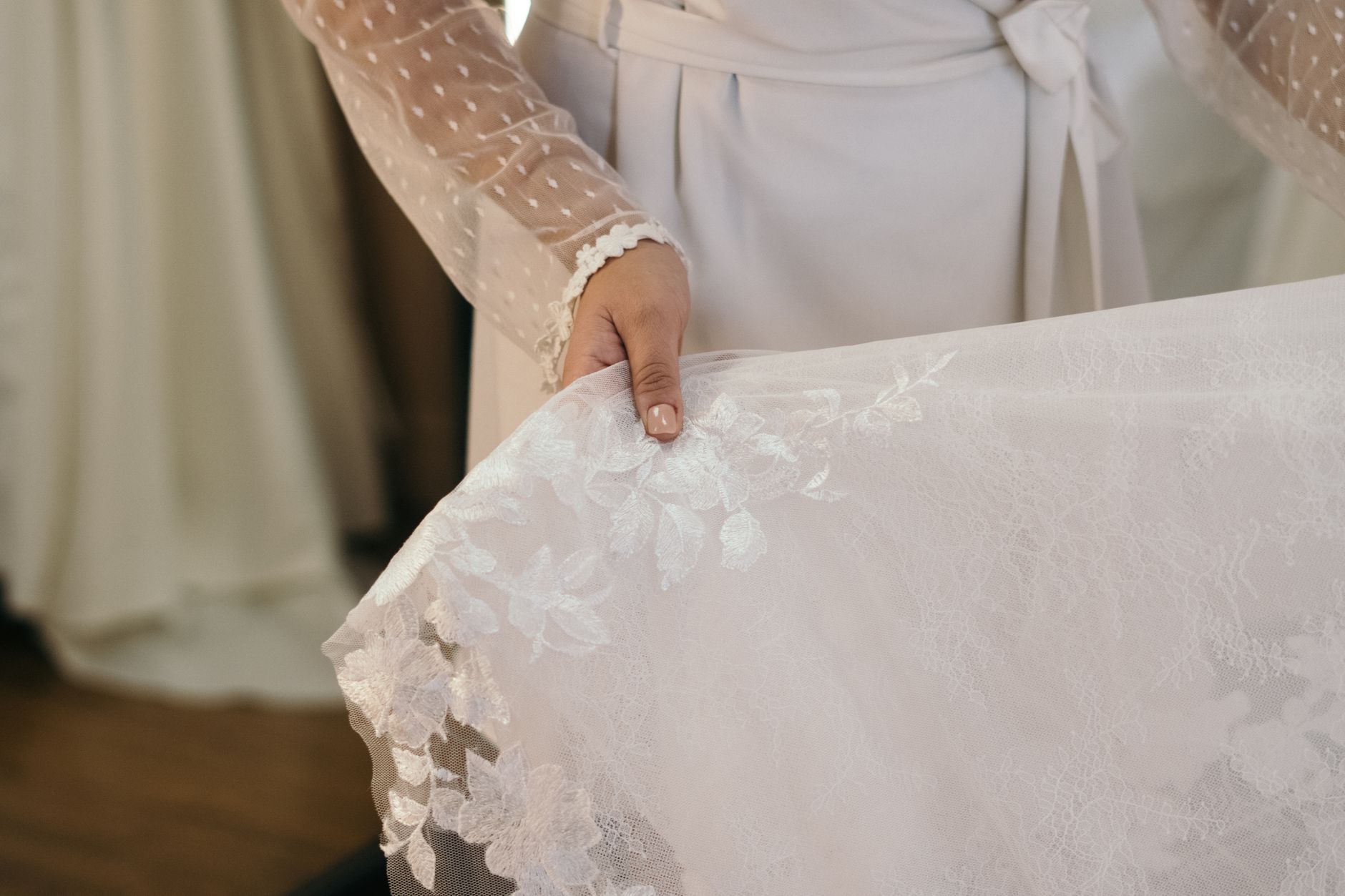
- Fine lace over a lining keeps the same silhouette with a touch of texture, for brides who want softness without shine.
How it behaves at a fitting
The slip cut is an honest cut, and that is its advantage. At a fitting, walk in it, sit down, raise your arms: the strap must stay where it belongs without pulling, and the back — often lowered or softly draped — must fall smoothly, with no folds gathering at the waist. Choose your underpinnings before the first serious fitting; with this silhouette they shape the final line more than with any other.
If the line feels too severe, change the layer rather than the dress. The same gown accepts a soft covering over the shoulders for the ceremony, removed easily afterwards. Its unhurried line also suits brides expecting a baby, because the fabric descends over the body instead of gripping it.
We keep gowns of this kind both to rent and to buy, in sizes 34 to 44. Fittings are private and arranged in advance, unhurried — a slip gown is only truly understood once you have walked in it before the mirror.