
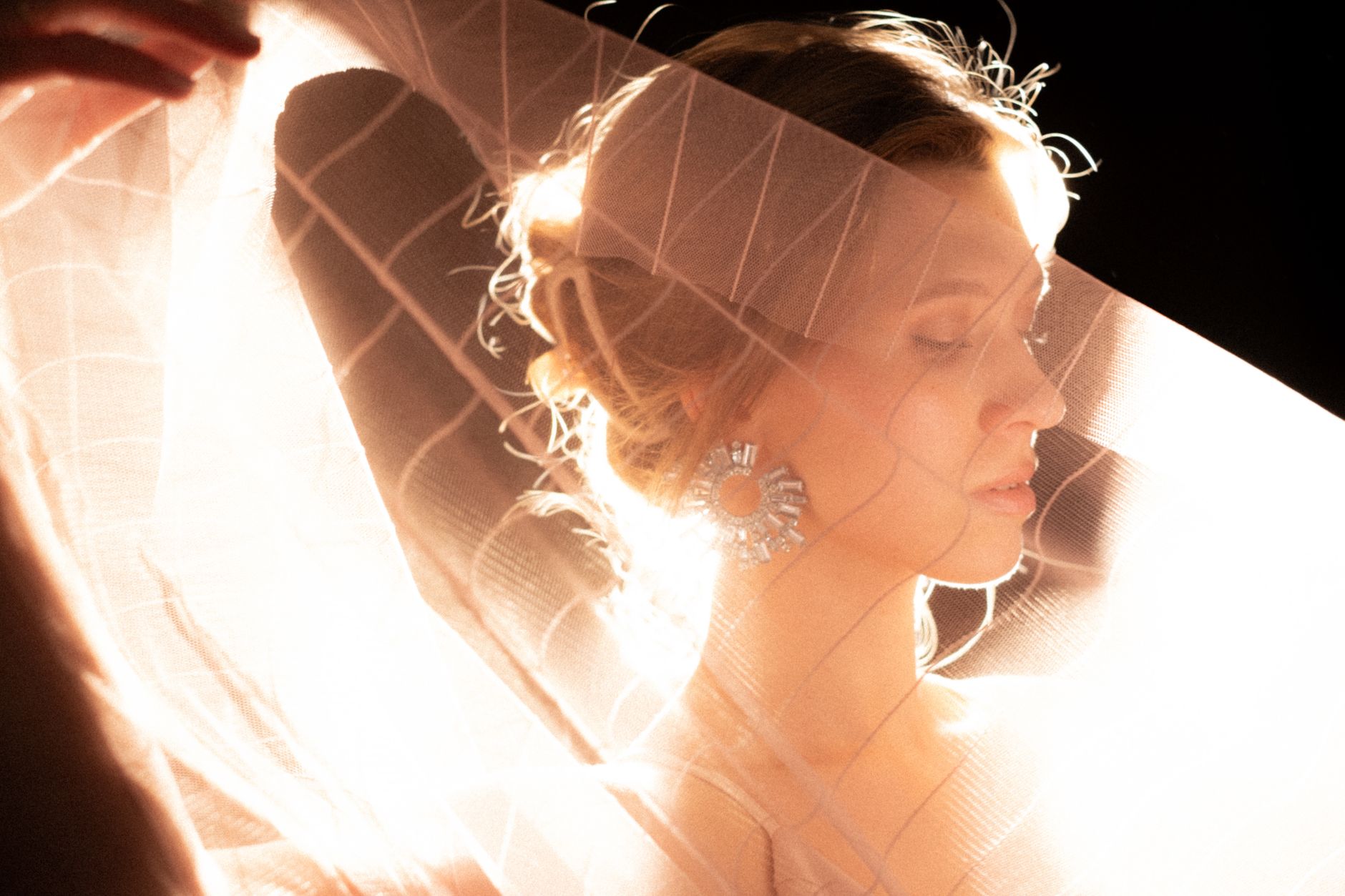
Pattern is returning to bridal quietly this season. In place of large floral appliqués and dense embroidery, we are seeing the dot: a small, evenly scattered point on tulle that all but disappears when the fabric is still, then comes alive the moment light moves across it. Dotted tulle spent decades confined to veils and underskirts. It has now climbed onto sleeves, bodices and whole skirts.
The size of the dot changes everything
Two gowns cut from dotted tulle can read entirely differently, and the only variable is the diameter of the dot and the space between dots. A fine dot, densely scattered, does not register as pattern at all but as texture: the fabric looks livelier, faintly grained, and stays discreet even in close photographs. A larger dot, more widely spaced, becomes a recognisable motif and lends a gown a note of playfulness and a certain retro calm.
One more thing is worth knowing. A dot shows most clearly where the fabric is drawn smoothly over the body or over a solid underlayer, and it softens in gathered, layered sections. The same tulle will speak plainly on a sleeve and merely shimmer through five layers of skirt.
Where dotted tulle sits best
- Sleeves and bodice — dotted tulle over a smooth foundation gives coverage without weight and leaves the arm room to breathe.
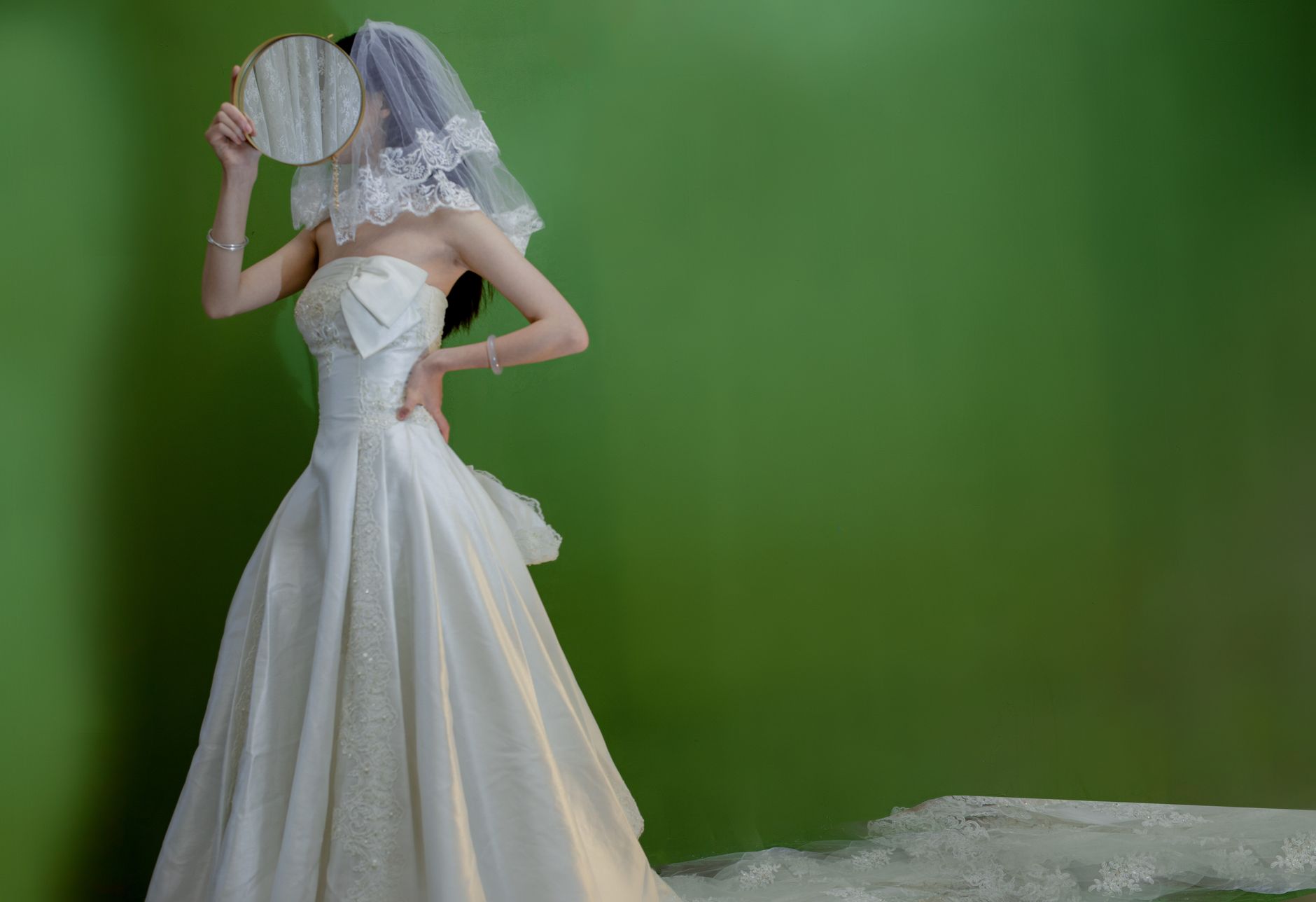
- The veil — this fabric's oldest address; the dot frames the face and removes any need for further ornament.
- A layered skirt — one dotted layer over matte satin is enough to give the whole silhouette depth.
- The entire gown — possible, but then the cut must stay calm: a clean neckline, no beading, no lace.
What belongs beside a dot, and what does not
The dot dislikes competition. Crystals and dense raised embroidery rarely flatter it; matte satin, crepe and a simple hem flatter it enormously. Watch the shade as well: the dotted layer and the fabric beneath it must come from the same family of white, because half a tone of difference turns a delicate pattern into a greyish haze.
Before you decide
Nothing alters a dot more than light. In daylight and under a camera flash it steps forward; by candlelight it recedes almost entirely into texture. At a fitting, ask to walk to the window and then back into the quieter depth of the salon, and look at the same fabric twice — the difference can settle the decision.
Our fittings are arranged in advance and held privately, without haste, in sizes 34 to 44, including cuts shaped for brides who are expecting; a dotted layer over a soft line is particularly kind here, veiling rather than gripping. Gowns may be rented or bought, and a rental contract holds across the border, which keeps things simple for brides coming from Serbia, Croatia and the diaspora.