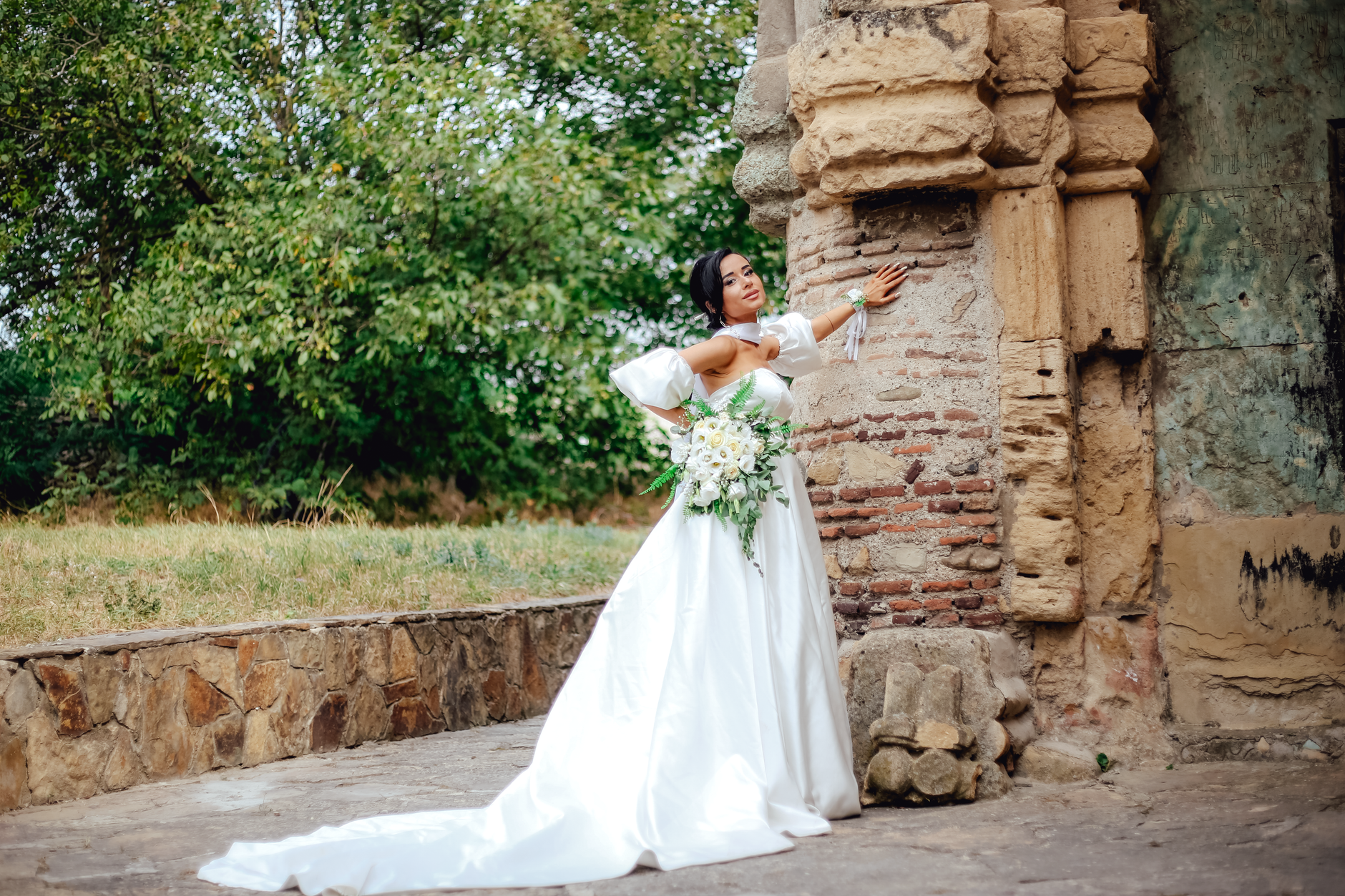

A layer that has been quietly out of favour is back beside the gown this season: the light scarf at the neck. It is neither a veil nor a cape, but a narrow length of fabric draped over the shoulders or looped once around the throat, with the ends left to fall down the back. Still when you stand, alive the moment you begin to walk.
Why a scarf rather than a veil
A veil is a veil, and no trend replaces it. A scarf simply does something else: it moves the eye from the head down to the neck, the shoulders and the collarbones, and it leaves the hair entirely free. No comb, no pins, nothing falling across the face. For a bride who wants an unadorned chignon, or who has never quite pictured herself beneath a veil, it is the gentlest possible alternative.
It is also practical. The scarf comes away in a second after the ceremony, and the gown beneath it remains complete. Outdoors, where the wind has its own opinions, the ends can be pinned discreetly or brought forward across the body, changing the look without touching the dress itself.
The fabric decides the character
- Chiffon — the softest fall, a matte shimmer, ends that sway with every step. The safest first meeting with this detail.
- Silk organza — holds its shape and stands away from the body, giving an almost sculptural line around the shoulders.
- Tulle — nearly invisible, closest in feeling to a veil, lovely in several layers.
- Crepe and satin — weight and a straight, upright fall; ideal with clean, minimal cuts.
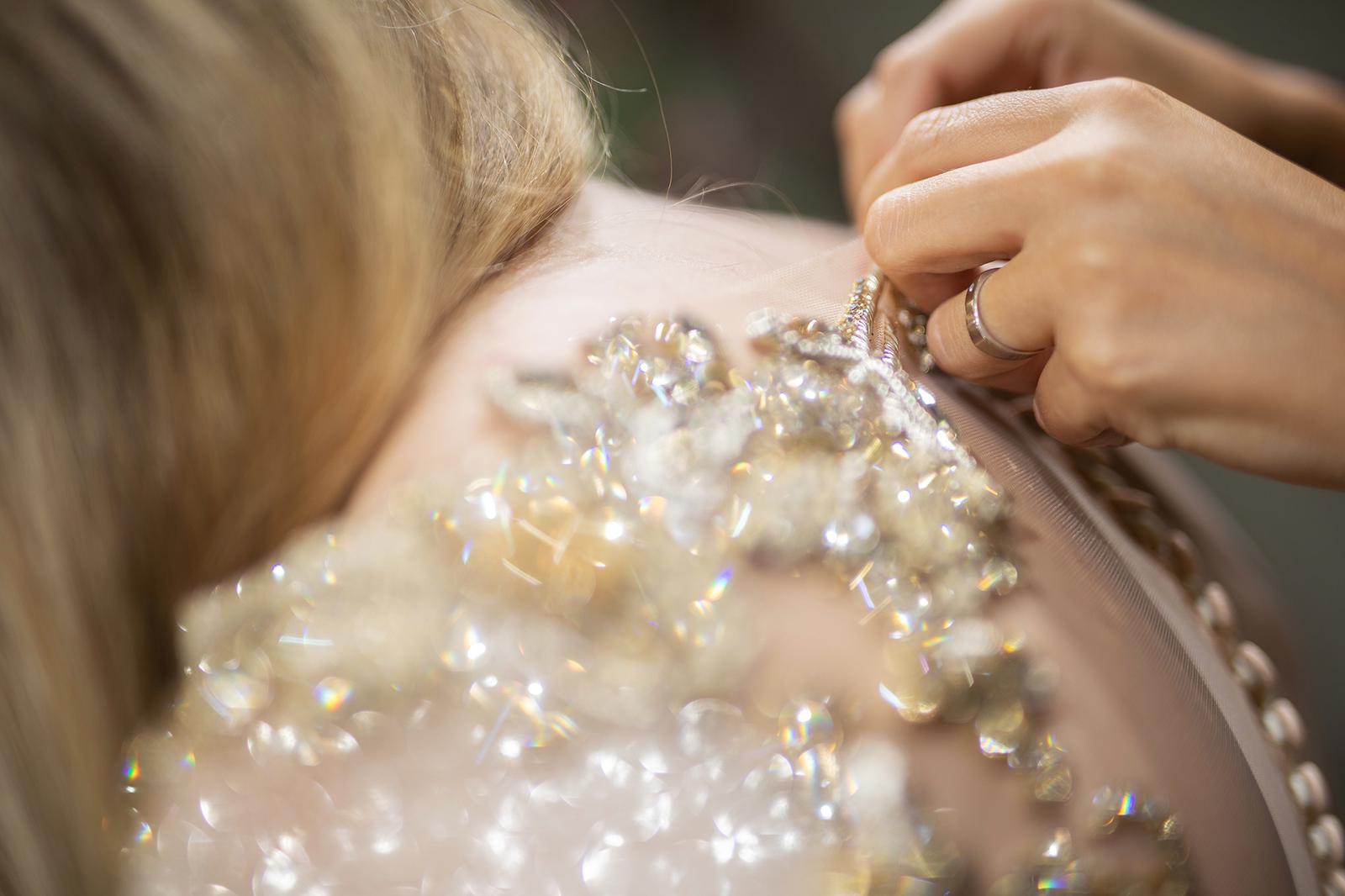
- Lace — the boldest choice, and one that asks for a gown with no other ornament at all.
Length follows the silhouette. A short scarf ends at the waist and reads almost as a soft collar; a mid length falls to the hips; the longest follows the train and photographs like a second, lighter train of its own.
Which gowns welcome it
The scarf breathes best in calm surroundings: a satin column, a simple A line, a smooth corset without embroidery, a heavy crepe skirt. Beside a densely beaded gown it is usually one layer too many. High necks and collars do not need it, while a deep V, a sweetheart line or a strapless bodice make an ideal frame, because the scarf gives shape to the open space above the bust.
With the soft lines chosen by expectant brides it works particularly well: the vertical ends draw the eye along the body and add lightness without adding volume.
What to test at the fitting
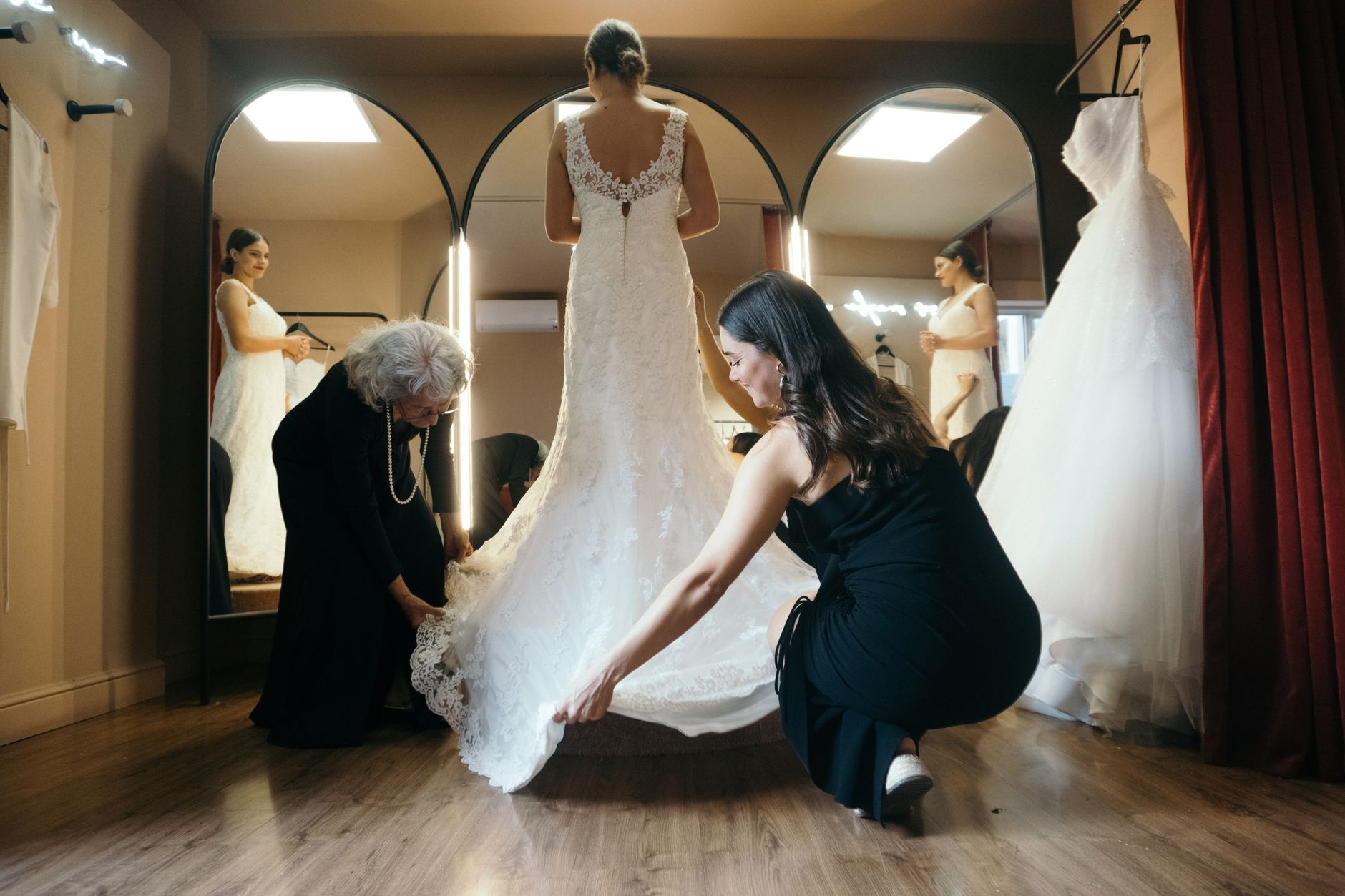
This is not a detail to judge standing still. Walk, sit, raise your arms, embrace someone; if the ends are in your way, the length is not yours. Try it with the hair you have planned and with your earrings, since a scarf and a statement earring rarely share the same space. In a private fitting by appointment it is easy to see the same cut with the scarf and without it, in sizes 34 to 44, whether the gown is to be rented or bought.